

Miracle Semple’s “The House Where Children Don’t Stay Quiet: A Laugh-Out-Loud Family Story Every Parent Will Recognize” is a warm, funny, faith-touched celebration of family life at full volume. Unlike the author’s more solemn testimony books, this work leans into comedy, daily chaos, and the emotional music of a busy home. It is not a book about perfect parenting. It is a book about real parenting, the kind filled with missing socks, dramatic morning routines, urgent questions, half-told stories, bedtime negotiations, and children whose voices fill every corner of the house.
The book begins with a simple truth: this is not a quiet home. The opening message invites readers into a house where everything happens at once. That line sets the tone for the whole story. The noise is not treated as failure. It is treated as life. Children call for their mother before the day is ready. Dreams turn into breakfast requests. Shoes disappear. Backpacks scrape across the floor. Someone always needs something. Yet beneath the comedy is a tender idea: a loud house can also be a blessed house.
One of the most enjoyable parts of the book is its ability to turn ordinary family stress into shared laughter. The first chapter captures the morning rush with accuracy many parents will recognize. Children wake up with urgency, questions, dreams, and demands. A simple morning becomes an orchestra, with everyone playing at once and no one following the same sheet music. The mother at the center of the scene is tired but steady. She is not untouched by the chaos, but she understands it. That mix of exhaustion and affection gives the chapter its charm.
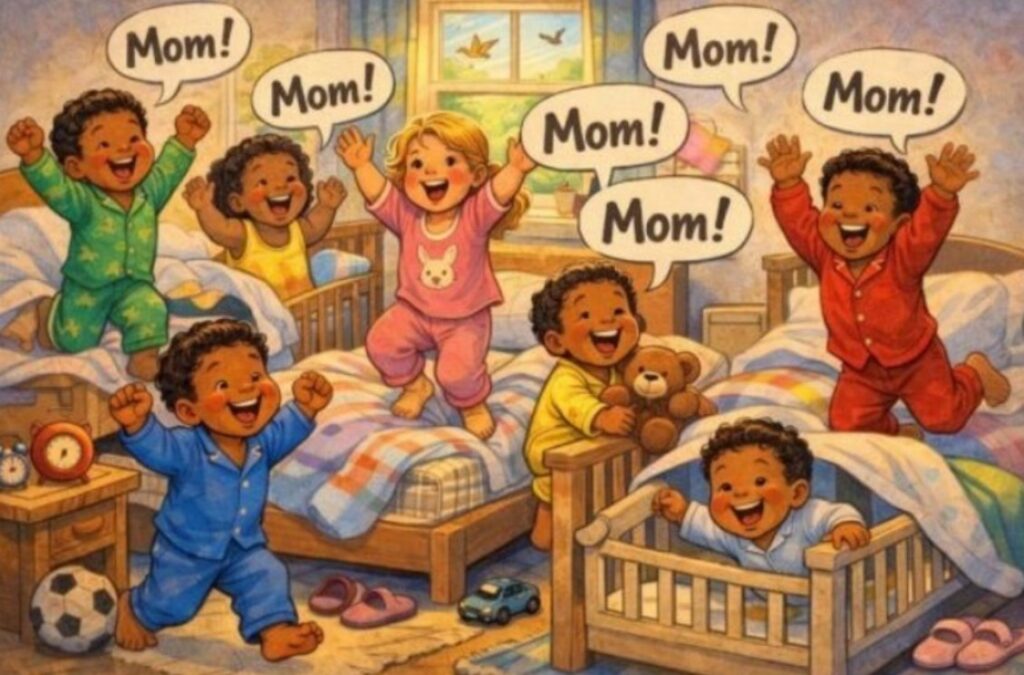
Interior illustration from the uploaded book file.
The second chapter, focused on missing belongings, is one of the clearest examples of the book’s humor. In this house, ownership is flexible. Socks vanish. Chargers migrate. Food disappears. The last cookie is eaten by “nobody.” Every child is innocent, confused, and suspiciously close to the missing item. The comedy works because it is not exaggerated beyond recognition. Many families know the strange mystery of household objects that disappear and reappear in the hands of someone who definitely did not take them. Semple uses these moments to show how children learn honesty, sharing, responsibility, and the art of surviving small domestic trials.
Another strong chapter explores children’s opinions. The book understands that children do not simply live in a home. They interpret it, question it, argue with it, and explain it back to the adults. Food is too hot, too cold, different from yesterday, or somehow wrong in a new way. Clothes are itchy, tight, or emotionally unacceptable. Bedtime is negotiable, at least in the child’s mind. The humor is affectionate rather than dismissive. Semple recognizes that these noisy opinions are part of children finding their voices. Guidance and boundaries matter, but so does the freedom to speak, reason, and grow.
The chapters on getting ready, school runs, and little reports continue that theme. Getting ready is described as a journey that begins with good intentions and slowly collapses into lost shoes, forgotten steps, sudden thirst, bathroom delays, and stories that must be told immediately. The school run becomes a moving stage where children remember tests, forget important items, and deliver reports before the car even reaches home. These scenes work because they capture a parent’s daily experience with both frustration and love. The reader laughs because the details feel true.
Food becomes another form of family language in the book. When the smell of cooking travels through the house, children appear with sudden sweetness, compliments, and unexpected helpfulness. A meal does not quiet the house. It changes the kind of noise. This chapter is especially warm because it shows the mother as a center of comfort. Her cooking gathers everyone. Her food becomes love made visible. Even the children’s dramatic praise feels like part of a ritual. The kitchen is not just a place of meals. It is a place where memory is made.
Public places add a larger stage for the family’s personality. The chapter about outings, loud joy, and the ankle with “memory” is a comic highlight. The family’s energy spills into malls, buses, skating places, and public spaces that pretend to be orderly until the children arrive. The scene involving the broken ankle is especially funny because it shows how children turn adult explanations into their own kind of logic. An ankle that “remembers” becomes a family joke, proof that children hear everything but translate it in wonderfully unexpected ways.
The hospital chapter, “The Smallest but Loudest Choir,” reveals the book’s tenderness beneath the laughter. The children visit an incubator room, trying to be gentle for about two seconds before curiosity and commentary take over. Babies cry, children whisper loudly, and the family turns even a serious environment into a moment of wonder. This chapter shows the emotional range of the book. It can be funny without being careless. It can enter a hospital and still find innocence, awe, and family warmth.
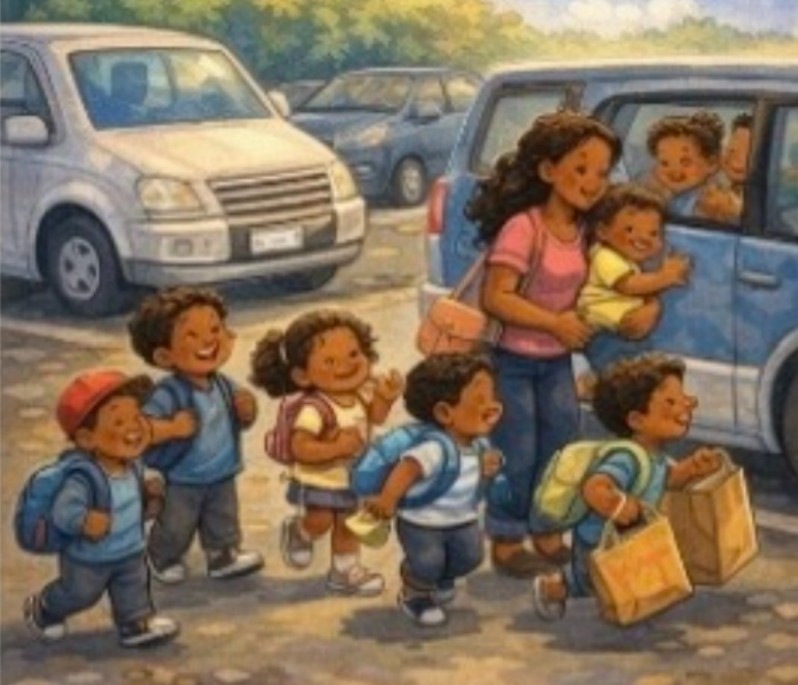
Interior illustration from the uploaded book file.
Grandma’s presence adds another layer to the household. The chapter about the funny eyebrow and Grandma stepping in shows how extended family helps regulate the chaos. Grandma does not need to shout to be understood. Her presence carries authority, humor, and memory. In many families, grandparents are the bridge between patience and discipline. Semple captures this with affection, showing that a busy house is not only built by one mother. It is held together by generations.
Faith also appears throughout the book, but in a gentler way than in the author’s testimony works. Here, faith is woven into the rhythms of home. It shows up in gratitude, prayer, songs, dancing, and the belief that even the mess has meaning. The house is loud, but it is also holy in its own way. Children laugh, argue, negotiate, dance, pretend to sleep, and ask for water at bedtime, but they are also being shaped by love. The book’s spiritual message is that family life does not need silence to be sacred.
The bedtime chapters are among the most relatable. Operation No Sleep and Bedtime Negotiations capture the universal parental struggle of trying to end a day that children refuse to release. Suddenly everyone needs water, one more hug, one more prayer, one more explanation, or one more reason to stay awake. The comedy is gentle because every parent knows bedtime is not only about sleep. It is about attachment, routine, imagination, resistance, and the child’s deep desire to remain connected.
What makes “The House Where Children Don’t Stay Quiet” valuable is its refusal to shame noise. Many parents worry that messy, loud, busy homes mean they are failing. Semple offers the opposite perspective. A noisy home may be a home where children feel safe enough to speak, laugh, ask, wonder, and be themselves. That does not mean there are no corrections or boundaries. The book clearly shows redirection, guidance, and parental fatigue. But it also honors the life inside the noise.
As an article subject, the book is ideal for parenting blogs, family magazines, church newsletters, and author features focused on motherhood and humor. It is light, approachable, and emotionally generous. Readers will see their own homes in its pages, especially if they have ever cooked while being complimented by hungry children, searched for missing socks that were never missing, or tried to explain that silence is suspicious.
In the end, this is a story about perspective. The same house that looks chaotic from the outside can feel full of grace from within. The same noise that exhausts a parent at noon can become the memory they miss years later. The same children who argue, giggle, interrupt, and negotiate bedtime are also filling the home with life. Semple’s book reminds parents that they are not failing because the house is loud. They are building stories, laughter, faith, and belonging. Quiet may come one day, but until then, the noise is proof that love is alive.
The illustrations strengthen this feeling. They give faces and movement to the household’s energy, showing children bouncing through mornings, arguing with confidence, arriving in public with excitement, and gathering around family moments with expressive joy. The visual style supports the tone of the writing because the pictures do not make the house look polished or stiff. They make it feel alive, colorful, busy, and emotionally familiar. For a reader, this matters. The images invite them to smile before they even finish the page.
The book also has strong market potential because it occupies a space many parents need. It is not a parenting manual, yet it comforts parents. It is not a devotional in the traditional sense, yet it carries gratitude and faith. It is not only for children, even though children will enjoy the scenes. It is truly a family book, something adults can read and laugh at because they recognize themselves, and something children can enjoy because they recognize their own voices.
Above all, the book honors the mother who keeps showing up. She is tired, amused, corrected by experience, interrupted constantly, and still present. That presence is the quiet strength behind the loud house. Her love does not require perfect order. It survives the missing socks, the repeated questions, the public adventures, and the late-night requests. That is why the ending feels meaningful. When silence finally comes, it is not empty. It is full of gratitude for the beautiful noise that filled the day.